Reach: How Anime Turns a Single Outstretched Hand Into Its Most Powerful Language
There's a moment in Spirited Away that lives rent-free in the heads of basically everyone who's ever watched it. Chihiro is dangling over the void, the spirit world threatening to swallow her whole, and then — a hand. Haku's fingers wrap around her wrist, and suddenly the whole film exhales. No speech. No dramatic musical swell that spells out what you're supposed to feel. Just a hand, and everything that hand means.
Anime has always been a medium that communicates through economy. Limited frames, careful line work, the strategic use of stillness — these constraints have pushed animators and directors to make every gesture count. And somewhere along the way, the outstretched hand became the genre's most loaded shorthand. It shows up in shounen battle arcs, in quiet slice-of-life conclusions, in tragic romances, in fantasy epics. The context changes wildly. The emotional weight, somehow, never does.
So what's actually going on when a character reaches out? And why does it hit so hard, every single time?
The Anatomy of a Reach
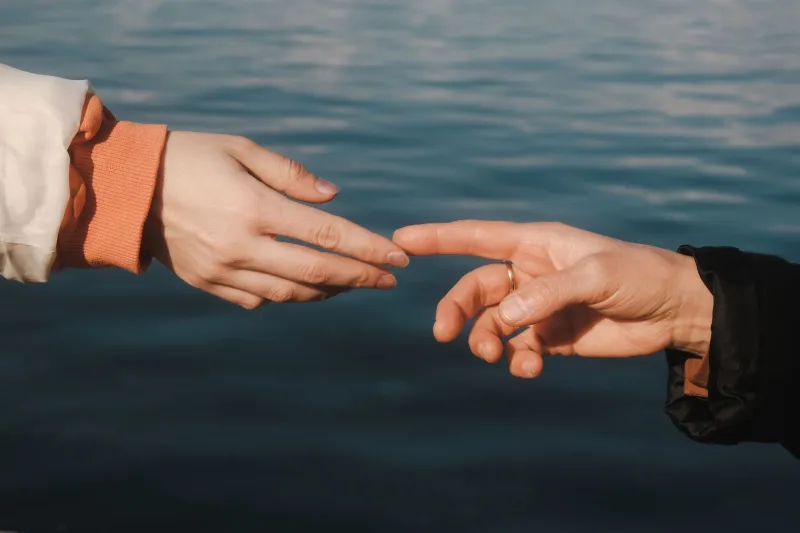
Before we get into specific series, it's worth thinking about what the gesture physically involves — because animators clearly do. A reach requires vulnerability. The arm extends away from the body, the hand opens, the person offering it literally makes themselves smaller and more exposed in the act. There's no guarantee the other hand is coming. That uncertainty is baked into the image.
Directors play with this constantly. Sometimes the reaching hand fills the whole frame — close-cropped, knuckles forward — which creates this almost claustrophobic intimacy. Other times the camera pulls back wide, and you see the full distance between two characters, the empty air between their fingertips looking enormous. Both choices are deliberate. The close shot says this moment is everything. The wide shot says this gap has a history, and crossing it costs something.
In Your Lie in April, Kousei and Kaori's relationship is basically choreographed through hands from start to finish. She grabs his wrist to drag him back into music. He steadies her when she stumbles. And in the film's most devastating sequences, the hands that once connected so easily are suddenly, cruelly absent. Naoko Yamamoto's direction understands that you can map the entire emotional arc of a relationship onto how two people's hands do or don't find each other. By the time you reach the end, even the memory of a reach is enough to wreck you.
Trust, Spelled Out in Fingers
Here's the thing about grabbing someone's hand: you are, functionally, agreeing to go where they go. At least for a moment. That's not a small thing, and anime leans into it hard.
The site name Teo Tsunaide Kaerou — hold my hand, let's go home together — is basically a thesis statement for why this gesture resonates so deeply with fans. Home isn't always a place in these stories. Sometimes it's a person. Sometimes it's a version of yourself you thought you'd lost. And the hand that reaches for yours is the thing that makes the journey back feel possible.
Frieren: Beyond Journey's End does something genuinely interesting with this. Frieren is an elf who has outlived almost everyone she's ever known, and her relationship to human connection is defined by how slowly she opens to it. When she reaches for Fern — or allows Fern to reach for her — the weight of centuries sits behind that gesture. It's not just two characters connecting in the present. It's an ancient being, for perhaps the first time, deciding that the risk of loss is worth the warmth of contact. The hand-reach in Frieren isn't about rescue. It's about choosing to be tethered at all.
Contrast that with how the gesture works in something like Fullmetal Alchemist: Brotherhood, where Edward Elric's automail arm reaching toward Alphonse carries constant, aching irony. He can feel nothing through that metal hand. The reach is real; the sensation isn't. It's a perfect visual metaphor for characters who keep striving toward connection while carrying wounds that make full connection feel just out of reach.
When the Hand Doesn't Arrive
Some of the most devastating uses of this motif are the ones where the hand never makes it. Where fingers stretch toward empty air.
Anohana knows this. Clannad knows this. Even lighter series use the missed or delayed reach to signal that something has shifted, that a relationship is in jeopardy. The gesture only works as powerfully as it does because it can fail. When a character reaches and finds nothing, the visual grammar the audience has been trained on turns against them. You feel the absence in your chest.
This is craft. It's the same reason horror movies teach you to expect the jump scare before they withhold it. Once you've seen enough anime to understand what a reaching hand promises, the directors who understand the language can use that expectation as a weapon.
Why American Fans Feel It So Acutely
For a lot of US fans who came to anime through fansubs, late-night Toonami blocks, or the more recent Crunchyroll era, these visual moments often land harder than they might in live-action Western media — and there's a reason for that. American film and TV tend to be pretty verbal. Characters explain what they're feeling. Anime, especially in its quieter registers, trusts the image.
For audiences raised on a diet of dialogue-heavy storytelling, there's something almost disorienting about a gesture that communicates this much without a single line. It asks you to slow down and look. And when you do, the payoff is enormous.
There's also something about the stylization that helps. Anime hands aren't photorealistic. They're expressive in a way that's almost theatrical — big eyes, exaggerated reach, fingers that seem to stretch just a little further than anatomy would allow. That slight unreality gives the gesture permission to carry more meaning than a real hand could.
Your Turn
We could keep going — A Silent Voice, Wolf Children, Princess Mononoke, honestly half of Makoto Shinkai's filmography — because this motif is everywhere once you start looking for it. But part of what makes this stuff worth talking about is that everyone's got their scene. The one that got them.
Maybe it's a reach you saw at age twelve that you still think about. Maybe it's something from a series you watched last month that left you staring at the ceiling. Either way, drop it in the comments. Tell us the series, the moment, and — if you're feeling it — what that particular reach meant to you.
Because at the end of the day, that's what this site is about. Holding onto the moments that held onto us first.